
QUESTIONS? CALL US AT 715.790.1322

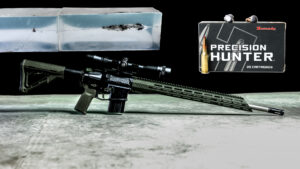
A Grendel Hunter .450 Bushmaster upper receiver on an Aero Precision lower with Magpul stock and grip, displayed alongside Hornady FTX, Hornady Soft Point, and Remington Core-Lokt ammunition used for ballistic testing.

Best .450 Bushmaster Hunting Loads: 100 & 200 Yard Ballistic Test

Tested Ammo
Muzzle Velocity (fps)
Muzzle Energy (ft/lb)
 
Hornady 250gr FTX | B.C. .210 (G1)
2,137
2,535
 
Hornady 245gr SP | B.C. .165 (G1)
2,240
2,729
 
Remington 260gr Core-Lokt | B.C. .171 (G1)
2,011
2,334
 

Tests conducted with a 16″ Grendel Hunter .450 Bushmaster Upper. Muzzle velocities measured with a chronograph using 10 round strings

Testing the “Thumper”: .450 Bushmaster Ballistics at 100 & 200 Yards 

The .450 Bushmaster has solidified its place as a premier straight-walled cartridge for the modern hunter. Having earned its reputation as the ‘thumper’ of the AR-15 platform, we wanted to determine exactly how much of that iconic ‘thump’ reaches the target once the bullet leaves the muzzle. To find out, we put three of the most popular factory hunting loads to the test: the Hornady 250gr FTX, the Hornady 245gr Soft Point and the Remington 260gr Core-Lokt. Using Clear Ballistics Gel, we analyzed each round’s expansion and energy transfer to see how well they truly perform at realistic hunting ranges.  

Our Testing Methodology 

When planning out these tests, we chose to shoot at 100 Yards, as this represents the most common distance where hunters zero their rifles and plan to take shots. At this range, we expected to see rapid expansion, a large wound cavity, and deep penetration.

We also chose to shoot at 200 Yards to determine if there is a drastic difference in performance as the velocity drops. This distance really tests the bullet’s ability to reliably expand at lower velocities and lower kinetic energy.

Hornady 250gr FTX Review | .450 Bushmaster 100-Yard Performance

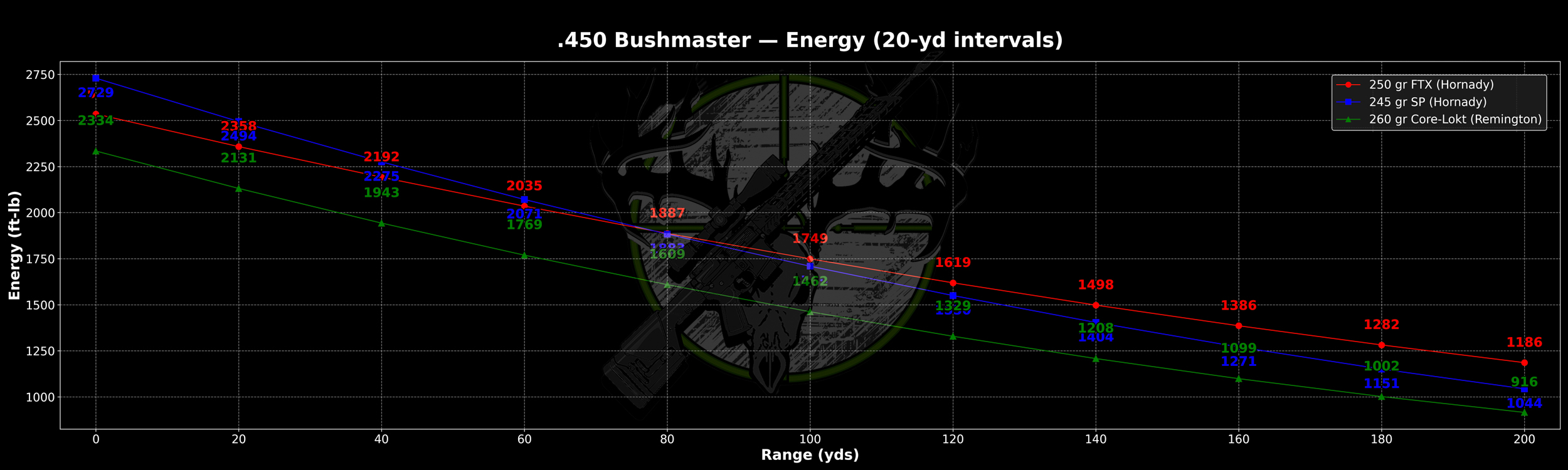
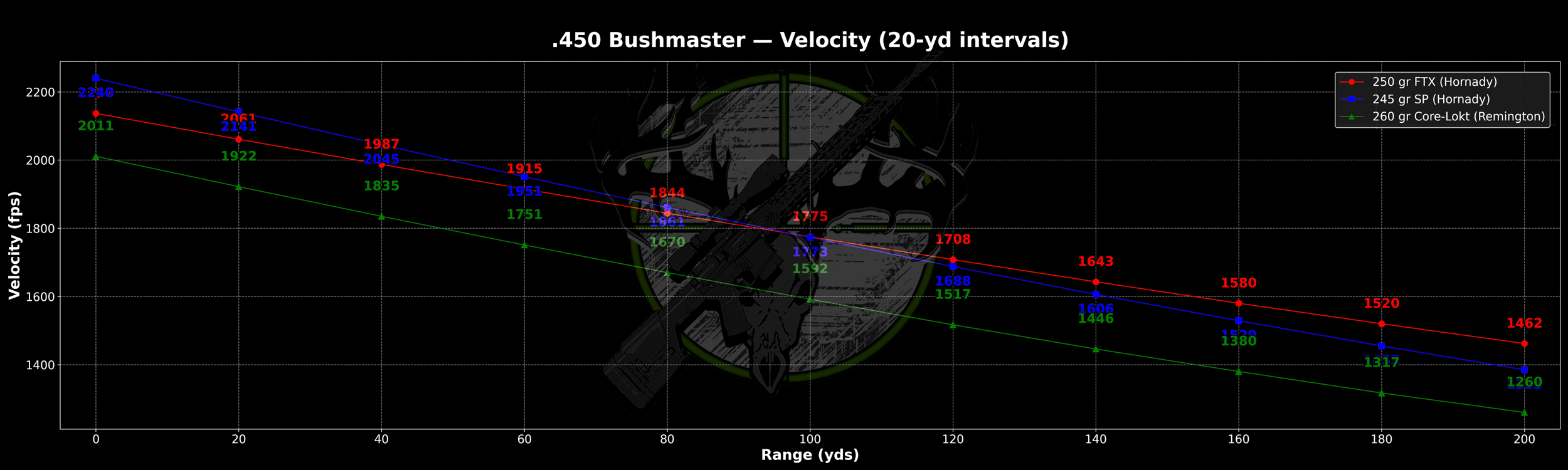
250gr Hornady FTX | 100 yard Velocity: 1,775 fps | Energy: 1,749 ft/lb 

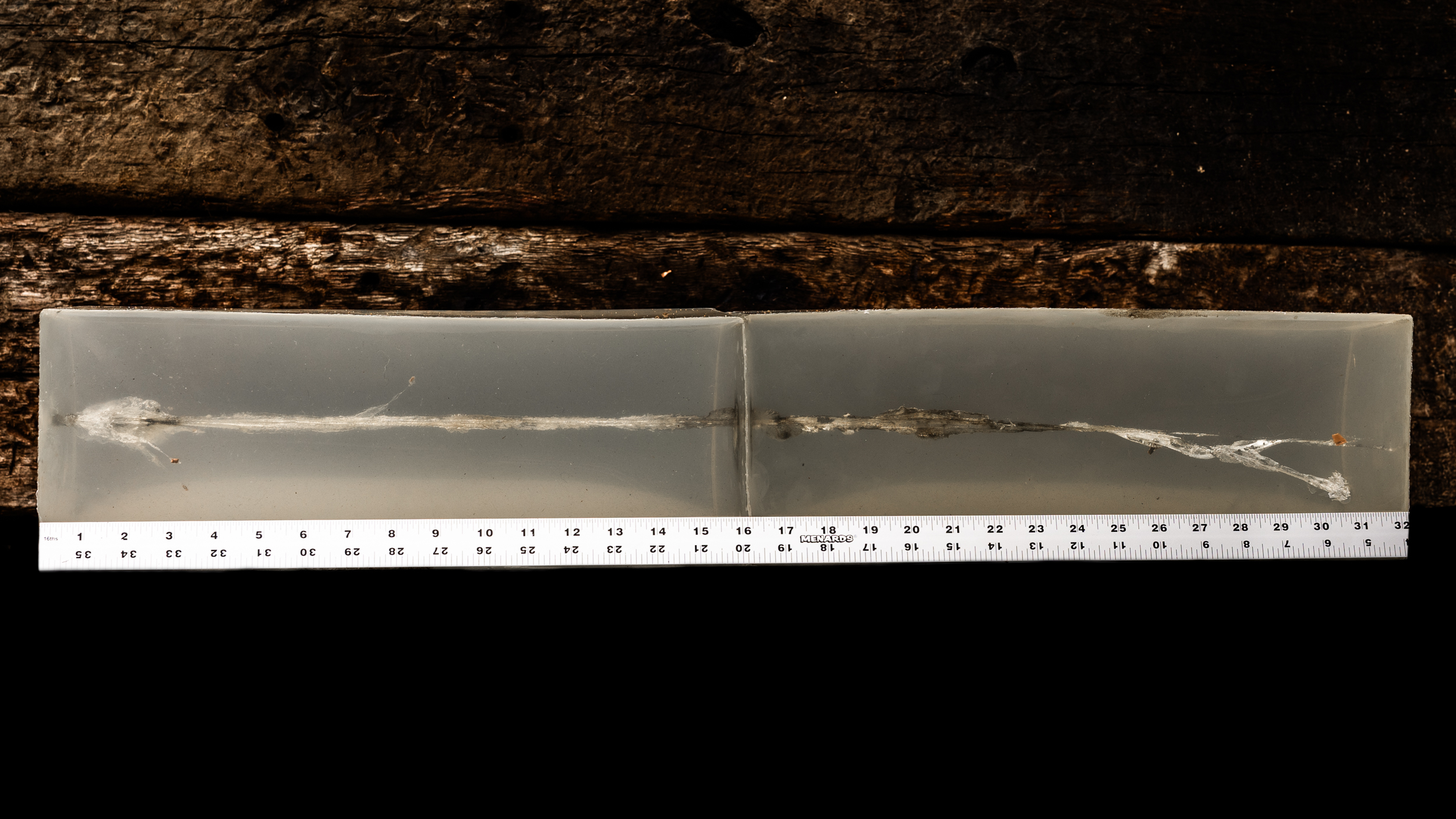
The first thing that stood out to us with the 250gr FTX was the sheer depth of penetration. The bullet tracked incredibly deep, nearly exiting the far end of our gel blocks. The expansion was instantaneous, creating a devastating wound cavity that maintained its maximum diameter through the 12-to-13-inch mark. Looking closer at the track, there were a lot of small lead and copper fragments spread out in and around the wound cavity, starting just a few inches in and trailing all the way to the 21-inch mark. But considering that the bullet we recovered was still at 85% of its original weight, its certainly not like the thing “grenaded” in there.

It was very impressive to see how much penetration this bullet had while still expanding this well and dumping a ton of energy into that first block of gel. Sometimes you have to choose between a bullet that fragments and dumps energy or one that stays together and punches deep, but the FTX is giving you both.

  • Retained Weight: 211.4gr (85% Weight Retention)

  • Expansion: 0.665” (1.48X Expansion)

.450 Bushmaster ballistic gel recovery: 250gr Hornady FTX expansion comparison.

Hornady 245gr American Whitetail Review | .450 Bushmaster 100-Yard Performance

245gr Hornady Soft Point | 100 Yard Velocity: 1,773 fps | Energy: 1,709 ft/lb 

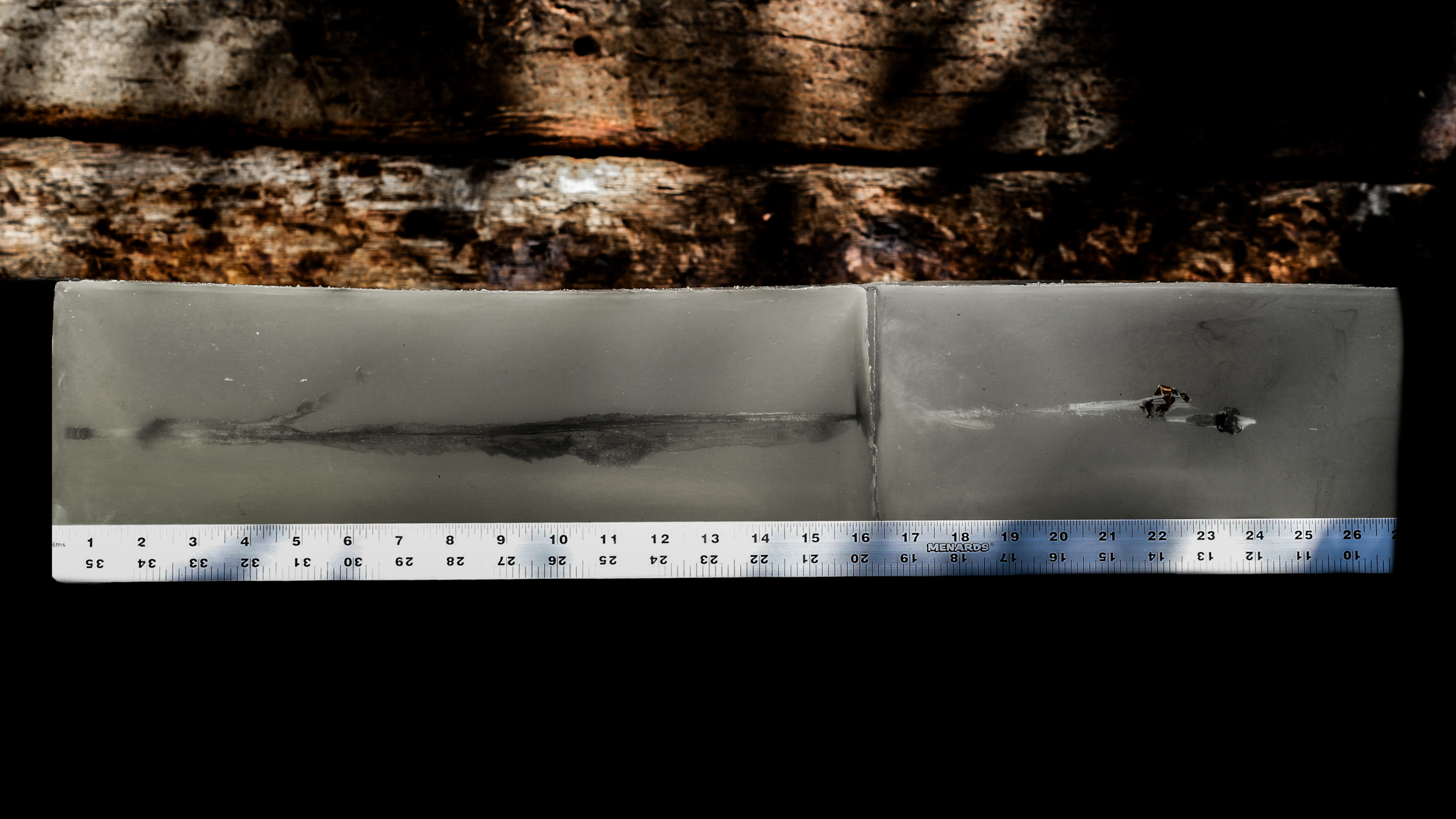
Next up we have the Hornady 245gr Soft Point, and as you can see, the results are very different compared to the 250gr FTX.

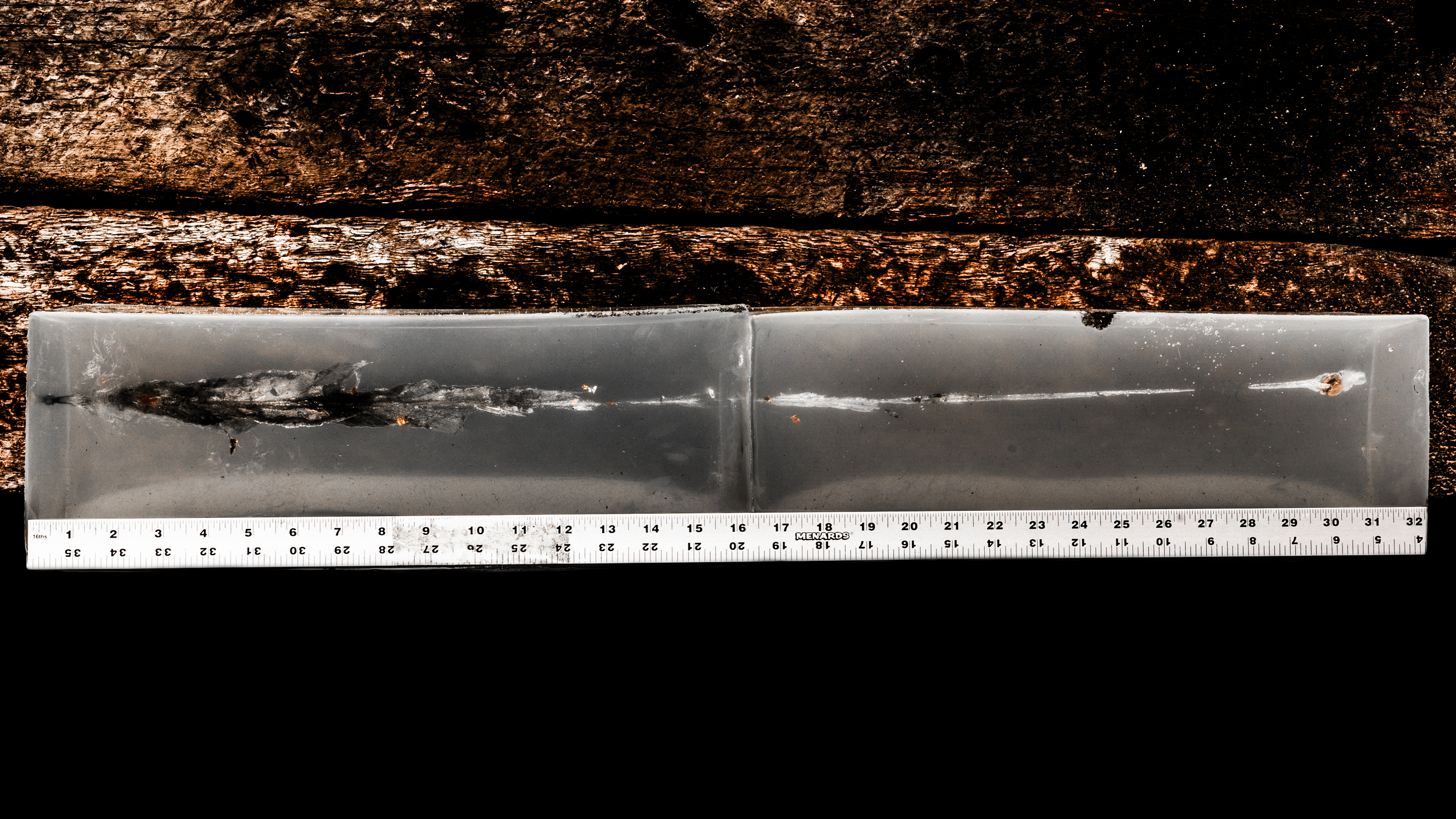
Even though this is an Interlock Soft Point, the expansion was surprisingly minimal. There is a small wound cavity in the first 3 inches, but then it closes right back down and creates a long, narrow channel (pretty much the size of the projectile) all the way through both blocks.

At around the 24-inch mark, the copper jacket actually peeled off and exited out the side of the gel block, while the lead core kept penetrating straight through and into the berm behind. We were able to recover both the lead core and the copper jacket, and as you can see in the image below, the lead didn’t expand at all.

Because these results were so unexpected, we didn’t just stop at one shot. We actually ran this test two more times to see if that first round was just a fluke, but the results were the same every single time. We even tried shooting it through leather to simulate animal hide, thinking the added resistance might jumpstart the expansion, but it didn’t make a difference.

It was interesting to see the lead core of this bullet stay so streamline across multiple tests. While it definitely has the penetration to get through just about anything, it didn’t give us that massive energy dump or wide wound cavity we saw with the 250gr FTX.

.450 Bushmaster ballistic gel recovery: 245gr Hornady Soft Point expansion comparison.

Remington 260gr Core-Lokt Review | .450 Bushmaster 100-Yard Performance

260gr Remington Cort-Lokt | 100 Yard Velocity: 1,592 fps | Energy: 1.462  ft/lb 

Now we have the 260gr Remington Core-Lokt, and it performed differently than both the FTX and the Soft Point.

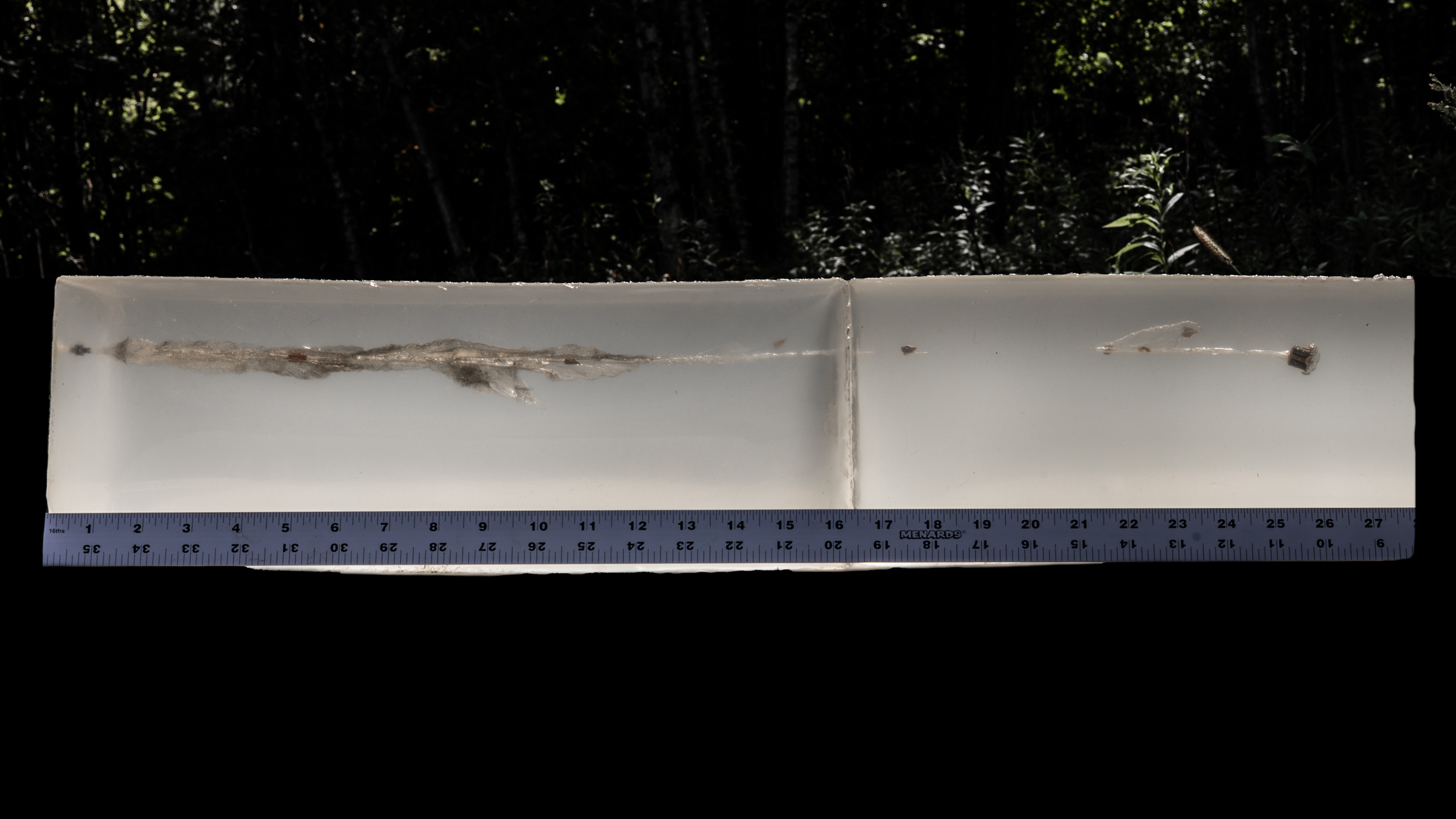
This bullet started to expand about 1 ½” into the block, and we got a very nice, consistently sized wound cavity all the way through that first block of gel. Other than one large copper fragment that tore off at the 3-inch mark and stopped around 6 inches, there was no other fragmenting at all. We did have jacket separation right at the end, but both the lead core and the copper jacket penetrated to nearly the exact same amount.

One of the biggest benefits we saw of the Remington Core-Lokt over the Hornady FTX is just how little fragmenting you get. While the FTX performed well at 100 yards with 85% weight retention, it still shed a decent amount of small copper and lead shards throughout the track.

This Core-Lokt only lost that one large copper fragment, meaning it held 96% of its weight together as it plowed through the gel. If you’re looking for a round that stays in one piece and creates a very predictable, consistent wound channel, this is a tough one to beat. 

Another thing to note is the penetration. While the other rounds were pushing 30+ inches, the Core-Lokt stopped right at the 24-inch mark. This is a great balance because it gives you plenty of depth but it doesn’t over-penetrate as much as the others. You’re getting a bullet that mushrooms perfectly and dumps all its energy where it counts.

  • Retained Weight: 251gr (96% Weight Retention)

  • Expansion: 0.733” (1.62X Expansion)

.450 Bushmaster ballistic gel recovery: Remington 260gr Core-Lokt expansion comparison.

Hornady 250gr FTX Review | .450 Bushmaster 200-Yard Performance

250gr Hornady FTX | 200 Yard Velocity: 1,462 fps | Energy: 1,186 ft/lb 

Now we’re stretching the 250gr FTX out to 200 yards to see if the “Thumper” still has enough gas to get the job done. Comparing it to the 100-yard shot, the wound cavity was actually fairly similar in length. It wasn’t quite as wide as the closer shot, but considering the bullet had about 570 ft/lb less energy at this distance, this performance wasn’t bad at all.

One of the best things about this result is that the bullet dumped its energy right in that first block where it counts, rather than wasting it in the second block. We ended up with 26″ of penetration, which is plenty for an ethical harvest at this range.

An interesting part of this test was the expansion. The recovered bullet had the exact same expansion as the 100-yard shot at 0.665”. Because it was traveling a bit slower, it didn’t fragment nearly as much as the closer shot, which boosted its weight retention up to 94%.

The Takeaway: It is clear to see that this bullet is plenty deadly at 200 yards. You’re getting the exact same expansion as you do at 100 yards, just with a little less shrapnel and slightly less penetration.

  • Retained Weight: 235.4gr (94% Weight Retention)

  • Expansion: 0.665” (1.48X Expansion)

.450 Bushmaster ballistic gel recovery: 200 Yard 250gr Hornady FTX expansion comparison.

4-Yards | 245gr Hornady Soft Point

The 4-Yard Experiment: 245gr Hornady Soft Point | Muzzle Velocity: 2,240 fps | Energy: 2,792 ft/lb 

Out of pure curiosity, we wanted to see what it would actually take to get the lead core of that 245gr Soft Point to open up. We knew it wasn’t expanding at 100 yard velocities, so we decided to see how it would perform at a much higher speed. We set the gel up just 4 yards away and let’s just say—it exploded this time!

From what we can tell, it seems like the lead in this specific load might be rather hard and brittle. It just wasn’t able to mushroom over at distance like we would expect, or like how we saw the Remington Core-Lokt perform. But at point-blank velocities, the lead core fractured into numerous large chunks.

In doing a little research after these tests, we found that others have performed similar tests with very different results. This leads us to wonder if there might be some inconsistency in the manufacturing—perhaps Hornady wasn’t able to source the same lead from one batch to the next and as a result, maybe not every box of the 245gr Soft Point ammo is created equal? We’re not quite sure.

However, in fairness to this bullet, we have to keep things in perspective. Even though it didn’t perform like we thought it would at 100 yards, at the end of the day, you’re still looking at a massive .452″ projectile hitting something really hard. Expanded or not, that is going to do a ton of damage to whatever is on the receiving end.

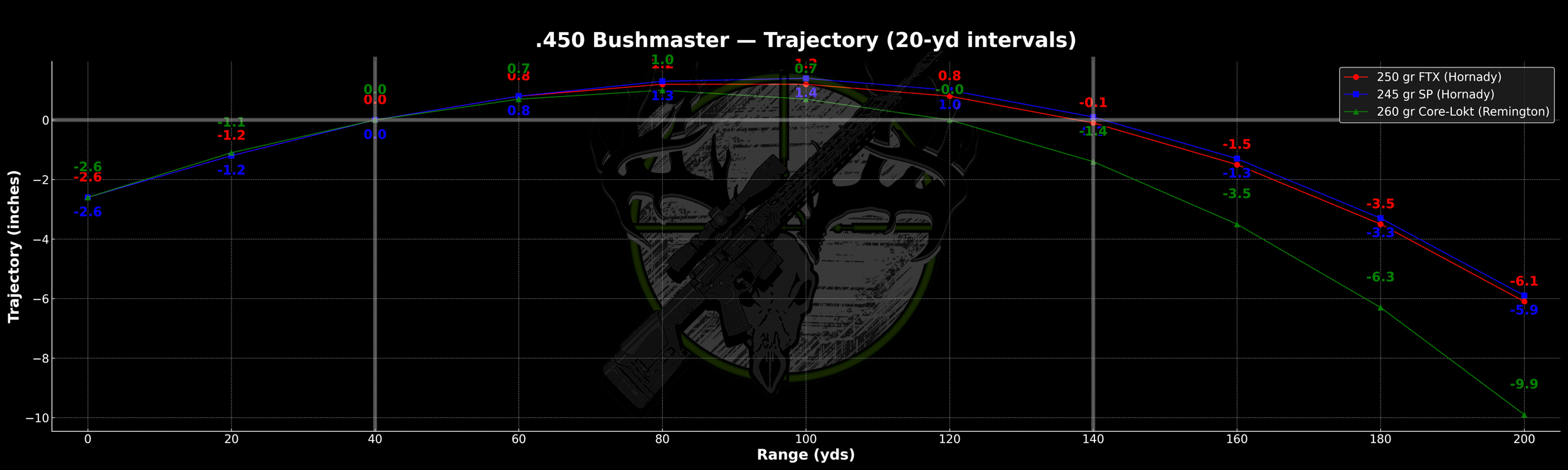
.450 Bushmaster Trajectory 

Trajectory chart showing .450 Bushmaster bullet drop from 0 to 200 yards comparing Hornady FTX and Remington Core-Lokt ballistic performance

Why We Zero at 40 Yards (40/140)

Finally, on the trajectory data, we found something kind of cool. With this caliber, you’re shooting a big, heavy bullet that isn’t moving super fast—it’s kind of getting lobbed out there, especially at the longer ranges. But we started playing around with a ballistic calculator to find a good hunting zero for our 16” barrel, and what we discovered was that 40 yards seems to be the perfect range.

Why the 40-yard zero works:

  • The “Double Zero”: On our AR-15, the scope height is 2.6″, so when the bullet leaves the muzzle, its traveling up to the line of sight until it intersects “zero”. The bullet then travels a little above zero and comes back down again. With a 40-yard zero, the bullet is back to zero again at 140 yards (though with the Remington Core-Lokt, it was closer to 120 yards).

  • Point-and-Shoot: From 20 yards all the way out to 160 yards, the bullet is never more than an inch and a half from your point of aim.

For us hunters, this is pretty useful. It means that for almost any shot we’re likely to take in the woods, we don’t have to worry about holdovers or complicated math— we just put the crosshairs on center mass and send it. 

Energy chart comparing .450 Bushmaster Hornady FTX and Remington Core-Lokt bullet energy from muzzle to 200 yards showing energy drop and long range performance
Velocity chart comparing .450 Bushmaster Hornady FTX and Remington Core-Lokt bullet speeds from muzzle to 200 yards illustrating velocity loss over distance

Final Thoughts

The .450 Bushmaster’s reputation as the ‘thumper’ of the AR-15 platform is well earned. It isn’t a flat shooting, high velocity, long range caliber. It isn’t as gentle recoiling as a 6mm ARC or 6.5 Grendel – Not even close. But boy does it thump. If you’re hunting in a straight-wall State or just want a super powerful brush and woods gun, then this caliber is what you want for those ranges.